
Agentic commerce has completely changed how consumers discover, evaluate, and buy products. But for CPG companies, the impact extends way beyond the shopping experience.
Rajib Chakrabarti, VP of Sales at Syren, recently explored this in his thought leadership article, Agentic Commerce in CPG: The Consumer Agent Is Only Half the Story. He explores how the two changes are developing together: consumer agents are increasingly influencing what people buy, and enterprise agents are helping CPG companies respond to those shifts through faster, more connected commercial decisions.
For CPG leaders, building agentic commerce therefore means looking at both sides.
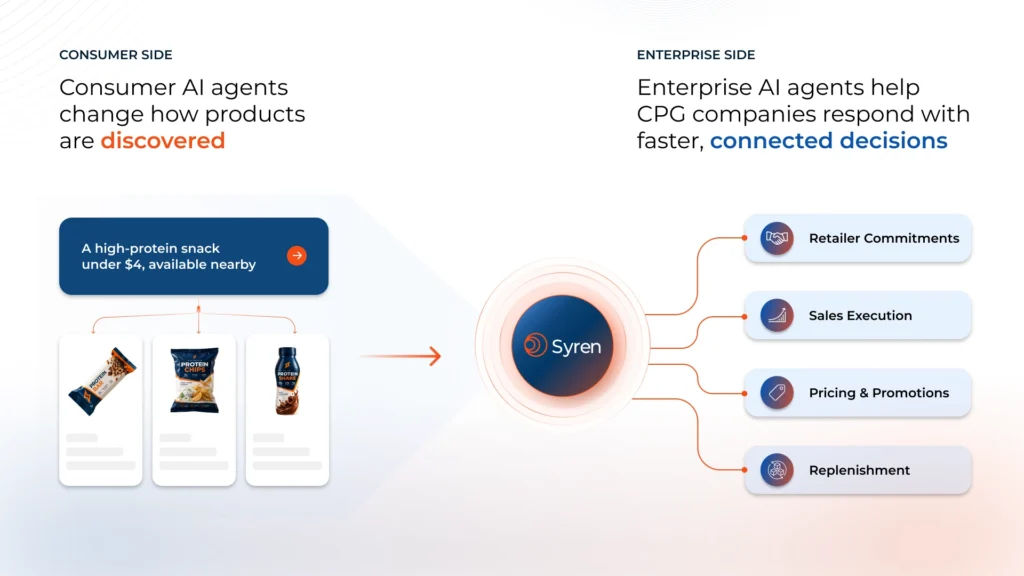
AI becomes the new storefront
CPG companies have already adapted from the physical shelf to the digital shelf, and agentic commerce introduces another layer: the algorithmic shelf.
A consumer may ask an AI assistant to look for the best high-protein breakfast product within a price range, no peanuts and available for delivery tomorrow. What the consumer does not do usually, is search by brand name. The agent does much of the filtering before the shopper even visits a single product page, making product information such as ingredients, pack size, nutrition, pricing and availability especially valuable.
Syren's data engineering and Databricks capabilities help CPG teams build that foundation that is structured and accurate enough for AI systems to confirm that a product matches the request.
Developments such as Google's Universal Commerce Protocol point toward commerce infrastructure where AI agents can participate more directly in discovery and purchasing.
But being discoverable is the first step. The next step is responding to the demand that discovery creates.
Enterprise AI agents help CPG companies respond
If AI agents make consumer demand more dynamic, the business behind the brand will needs to react at a similar speed.
A change in demand can quickly affect pricing, promotions, inventory, retailer commitments, and replenishment. The information needed to make these decisions often sits across different teams and systems. Take for example, a promotion: revenue growth management sets the price based on expected uplift and margin; supply chain maintains its view of inventory, and sales manages commitments with key retail accounts. When demand shifts, these views need to come together at once.
Enterprise AI agents continuously evaluate demand, inventory, pricing, account value and commercial commitments, then surface where attention or action is required, while humans control the final decision. This is particularly valuable when teams cannot realistically monitor every customer, SKU, market or commercial decision themselves. Syren's AI Pricing Agent and Agent Studio are built for this kind of connected decision-making.
Syren's enterprise AI agents can help identify missed reorder opportunities across smaller retail accounts using information such as product availability, pricing, and substitutes. The agents help sales teams focus their attention on where it’s most useful. Our agentic AI solutions apply the same approach across commercial operations.
Where should CPG companies begin?
The starting point must be a focused decision on choosing a system where the outcome is measurable; the necessary data already exists, and human approval can remain part of the workflow. Replenishment, sales execution, pricing, and promotions are natural examples.
The larger step is creating the operating model around the agent: what information it can use, what it can recommend, where people approve decisions, and how exceptions are handled.
Deloitte's 2026 research found that 40% of CPG companies had no defined approach to agentic commerce even as many were already piloting related capabilities. That foundation matters because adoption is already moving quickly.
Preparing for both sides of agentic commerce
CPG companies need to be prepared without knowing exactly how quickly consumers will adopt AI-assisted buying. What they can do, however, is prepare on two fronts: making product information easier for AI agents to interpret and recommend, and strengthening the data and decision systems needed to respond to the demand those recommendations generate.
For a leadership perspective behind this discussion, read Rajib Chakrabarti’s LinkedIn Pulse article.