

In a recent article, Syren’s COO, Mohammed Vasim, shares a grounded perspective on customer experience that challenges how many organizations think about it. His core message? Customer experience is shaped long before a customer interacts with a brand and is, not surprisingly, determined by how the organization operates internally.
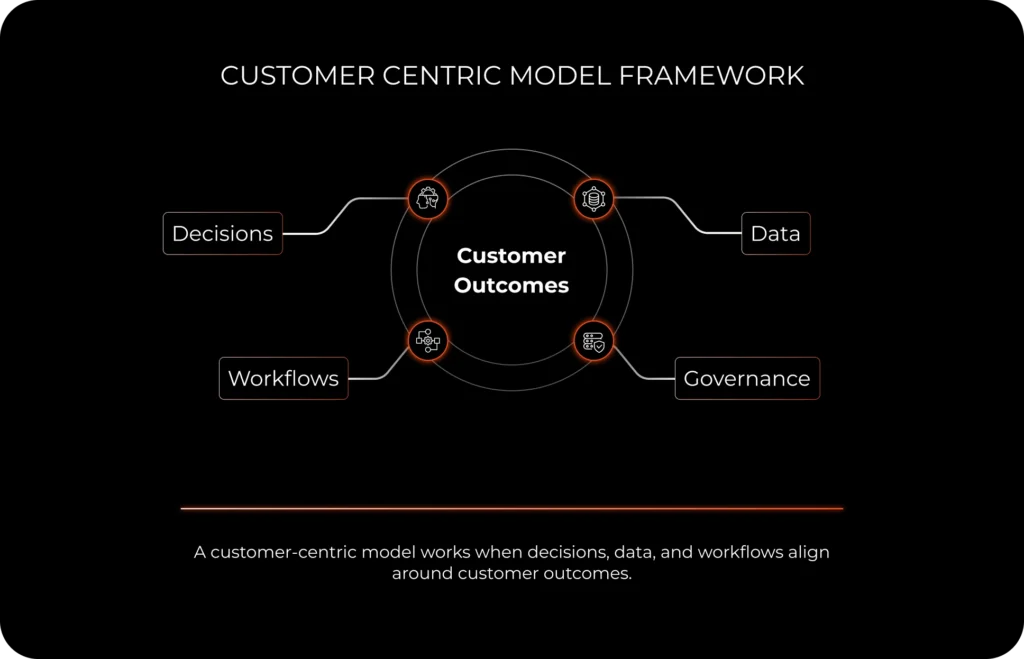
Vasim describes customer experience as the outcome of decisions made across operations, data, and workflows. Inventory accuracy determines whether promises can be kept. Data reliability influences the confidence of customer-facing teams. Workflow design affects how quickly issues are resolved, or whether they surface at all. Customers may never see these mechanisms, but they feel the results immediately.
Vasim views customer experience not as a front-office function, but as the outcome of everyday decisions made across operations, data, and workflows. Inventory accuracy influences whether commitments can be honored. Data reliability shapes the confidence of customer-facing teams. Workflow design determines how quickly issues are resolved, or whether they surface at all. Customers may never see these internal mechanisms, but they experience their impact immediately.
He also highlights another common disconnect across organizations. While significant investments are made in improving customer-facing touchpoints, internal systems often remain fragmented, reliant on manual handoffs, and driven by reactive processes. This imbalance shows up as inconsistent service, delayed responses, and avoidable errors, even when teams are working with the best intentions.
Underlying all of this is a simple message: customer experience is shaped by operational design. When internal friction exists, it eventually reaches the customer. When operations quietly deliver accuracy and predictability, experiences feel effortless.
That perspective naturally leads to a practical question. If customer experience is rooted in operations, how do organizations design themselves around the customer in a way that holds up at scale?
What Is a Customer Centric Model in Practice?
A customer-centric model is often described as a mindset. In execution, it functions as a system that guides decisions across teams, processes, and technology.
Unlike traditional operating approaches that prioritize internal efficiency first, a customer-centricity model evaluates decisions through customer impact alongside cost, speed, and risk. When done well, it creates consistency across the organization, even as complexity increases.
Most customer-centric business models fail because the operating model underneath is fragmented, not because the intent is wrong.
How to Design a Customer-Centric Business Model Step by Step
Designing a customer-centric business model is less about experience design and more about operational alignment. The steps below focus on how customer centricity is built into day-to-day execution.
Step 1: Define Customer Outcomes Operationally
Move beyond journey maps. Define customer outcomes in operational terms such as delivery reliability, response predictability, and information accuracy.
Step 2: Identify Decisions That Shape Those Outcomes
Map the operational decisions that influence customer outcomes. These often sit in forecasting, fulfillment planning, exception handling, and service workflows.
Step 3: Build a Customer Centric Operating Model
A customer-centric operating model aligns teams around shared data, incentives, and consistent decision logic, reducing conflicting actions across functions.
Step 4: Shift from Reactive to Preventive Workflows
Customer-centric models prioritize early detection and resolution. Workflows are designed to prevent issues rather than respond after customers are impacted.
Step 5: Embed Customer Impact into Governance
Customer centricity must survive scale. Governance frameworks should evaluate trade-offs through the lens of customer impact, ensuring customer intent remains embedded in decision-making over time.
Key Metrics to Measure Customer Centricity Success
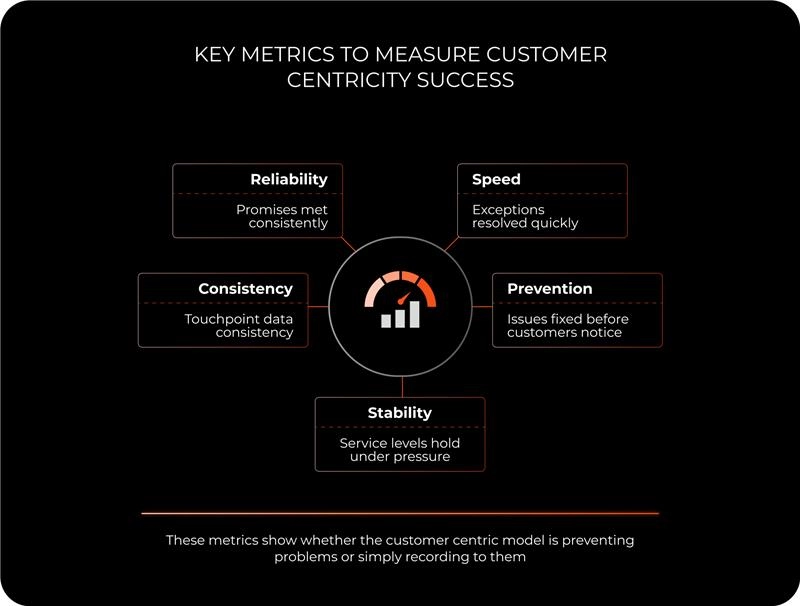
Measuring customer centricity requires more than satisfaction scores. Effective customer-centric business models rely on operational metrics that act as leading indicators.
Key metrics include:
- Reliability: Accuracy of customer-facing commitments
- Speed: Time to resolve exceptions without escalation
- Consistency: Structured data across customer touchpoints
- Prevention: Percentage of issues resolved before customer contact
- Stability: Service variability during peak demand
These metrics reveal whether the customer-centric model is designed to protect outcomes by default.
Companies with Customer-Centric Models that Work
Organizations with strong customer-centric models share one common trait, operational discipline. Customer focus, in these cases, is not an abstract value but a principle embedded into how decisions are made every day.
- Amazon designs its operating model around delivery reliability and customer convenience, even when it increases internal complexity.
- Apple embeds customer centricity across product, supply chain, and retail operations to maintain consistency at scale.
- Netflix aligns personalization decisions with real-time data and operational feedback loops.
In each of these examples, customer centricity is reflected in decision-making structures, not just in how experiences are presented externally.
This discipline is not limited to digital-native companies. In complex enterprise environments, customer outcomes depend just as heavily on how data, workflows, and fulfillment decisions are designed.
In Syren’s work with global enterprises, enhancing On-Time-In-Full (OTIF) performance by breaking fulfillment outcomes into milestone-based tracking has significantly reduced delays and improved predictive control across the entire order lifecycle.
How to Create Customer Personas for Customer Centric Strategies
Customer personas play a critical role in customer-centric models, but only when they influence operations.
Operationally useful personas include:
- Contextual needs under different demand conditions
- Sensitivity to delays, errors, or inconsistencies
- Preferred resolution paths
- Likely escalation behavior
These personas should inform workflow design, automation rules, and prioritization logic. When personas remain confined to marketing artifacts, customer centricity loses operational relevance.
Tools and Technologies That Support Customer Centricity Initiatives
Technology enables customer-centric business models only when it reinforces alignment.
Common enablers include:
- Unified data platforms that ensure consistent customer information
- Workflow orchestration tools that reduce manual handoffs
- Automation for early issue detection and exception handling
- Analytics layers that surface customer-impacting signals in real time
Why Customer Centric Operating Models Scale Better
Customer-centric operating models reduce reliance on individual effort and institutional memory. They create systems that behave predictably under pressure.
When designed correctly, these models:
- Absorb demand variability without degrading service
- Reduce escalation and rework
- Enable faster, more confident decisions
- Maintain consistency across channels and regions
This is what allows customer-centric business models to scale without losing trust.
From Customer Centric Thinking to Competitive Advantage
Customer centricity becomes durable when it is embedded into the operating model rather than layered on top of it. The most resilient organizations treat customer outcomes as a design constraint, not a reporting metric.
At Syren, we approach customer-centric models as a systems problem that requires alignment across data, workflows, and decision intelligence.
For a leadership perspective that sets the foundation for this operational view, read our COO’s LinkedIn Pulse article.