

At Syren, we believe Speed Building defines the next era of enterprise software engineering — where AI brings acceleration and engineers preserve the soul.
The Changing Rhythm of Software Engineering
Every few months, a new idea reshapes how the world thinks about building software. From the early promises of low-code platforms to the rise of AI-assisted development, each wave has aimed to close the gap between human intent and machine execution.
In early 2025, the phrase vibe coding, coined and popularized by Andrej Karpathy, caught the imagination of engineers across the globe. The idea was simple yet bold: describe what you want in natural language, and an AI system powered by large language models (LLMs) translates that into executable code.
For developers, it felt like magic, the possibility of turning thought into code. For startups and creative builders, it opened new ways to prototype and experiment.
But as our Director of Engineering, Bharat Meda, highlights in his recent article Speed Building: Where AI Meets the Soul of Software Engineering, the story changes dramatically when this concept enters the enterprise world.
So, what exactly is Vibe Coding?
Think of vibe coding as intent-driven development. You describe what you want in natural language, and the system, often powered by a large language model (LLM) or a generative AI platform, figures out how to make it happen.
It’s like telling your senior developer: “Hey, can we build a dashboard that compares monthly sales across regions and highlights anomalies?”
Within seconds, the AI translates that request into working code, connects APIs, and sets up data pipelines. That’s the “vibe”: your intent, your flow, your problem-solving energy, turned into executable code.
What Speed Building Brings to Enterprise Engineering
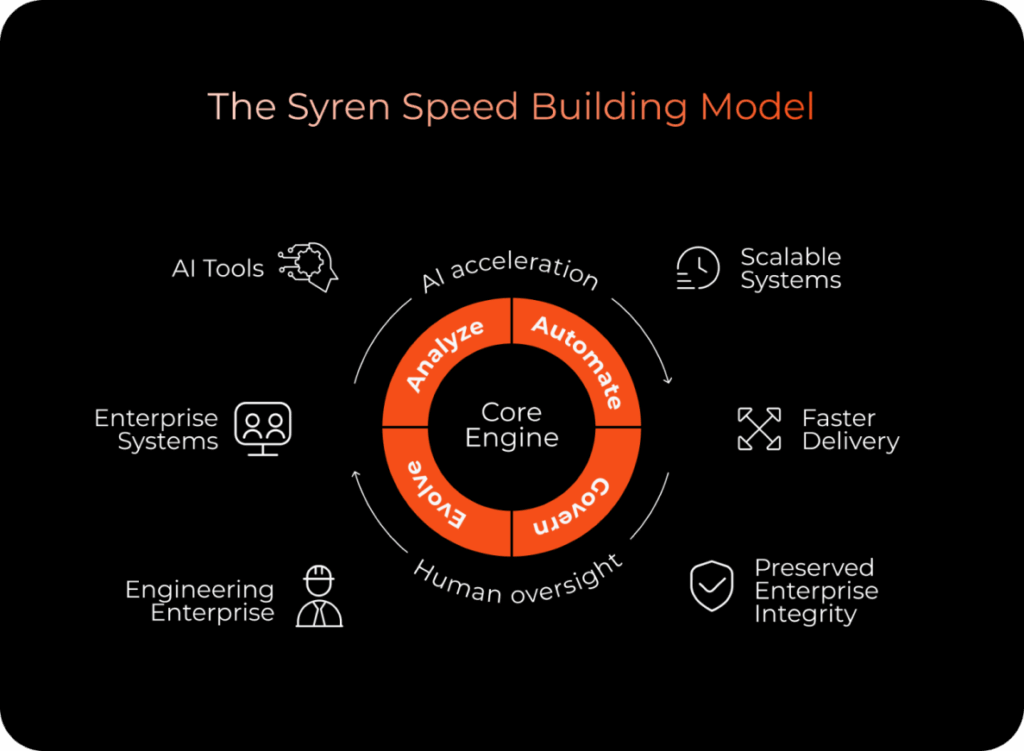
Speed Building takes the creative spark of vibe coding and grounds it in enterprise reality. It’s a philosophy where AI handles acceleration, summarizing, refactoring, automating, and generating, while engineers bring judgment, governance, and structural awareness.
As Bharat puts it: “AI provides acceleration, and engineers provide direction.”
It’s how teams maintain compliance, manage cross-functional dependencies, and design long-term reliability even as AI enhances how they work. Speed Building is not a new framework. It’s a new rhythm of collaboration between human expertise and machine capability.
From Vibe Coding to Speed Building: The Shift Enterprises Need
The difference between these two paradigms is subtle but profound. Vibe coding showed what’s possible when AI meets creativity; Speed Building shows what’s sustainable when AI meets complexity.
At its core, Speed Building turns generative potential into governed performance, ensuring that speed doesn’t outpace structure. Engineering teams can modernize legacy systems safely, design new solutions faster, and maintain the integrity of enterprise ecosystems.
This evolution also mirrors a broader transformation happening across the AI landscape, a shift we’ve explored in our recent insights on agentic AI vs generative AI. Just as enterprises are moving from AI that creates to AI that acts with context and reasoning, engineering is moving from code generation to system orchestration, the essence of Speed Building.

How Speed Building Fits into Syren’s Broader AI Vision
At Syren, we see Speed Building as a cornerstone in the continuum of AI-driven enterprise transformation, alongside our work in data, supply chain intelligence, and agentic automation.
Our teams are applying these principles across industries, combining AI-driven orchestration with human insight to make systems not just faster, but smarter. This thinking also drives our approach to AI consulting for supply chains, where acceleration means little unless it’s paired with governance, transparency, and domain context.
The Three Contexts of Speed Building in Action
1. Change Management and Quick Wins
Many enterprises begin their journey here, automating documentation, dependency mapping, or regression testing.
These are high-effort, low-risk tasks that AI handles efficiently, giving teams more time to focus on architecture, reliability, and user experience. It’s where momentum builds.
2. Greenfield Development with Governance
In new builds, AI becomes the fast hand while engineers remain the guiding mind. Speed Building enables rapid scaffolding of APIs, data pipelines, or services, but within enterprise constraints of security, integration, and compliance.
This blend of speed and scrutiny lets innovation scale safely.
3. Organizational Evolution
Over time, Speed Building transforms how teams think.
Engineers learn to prompt, validate, and co-develop with AI, turning it from a novelty into a daily collaborator.
As AI explains legacy logic and accelerates documentation, engineers gain a deeper understanding of their systems.
From AI Agents to Enterprise Engineers: Shared Intelligence
Speed Building also complements the rise of agentic AI; these systems represent a leap from simple task automation to AI that plans, reasons, and collaborates across workflows.
In practice, this means engineers no longer work on systems but work with them. AI tools detect inefficiencies, suggest fixes, and automate repeatable work, but the engineer defines the scope, validates the logic, and ensures alignment with enterprise goals.
Speed Building becomes the execution layer of that vision, where AI agents and human engineers operate as co-builders in a governed, context-aware environment.
How Syren Builds Speed with Structure
Across Syren’s data engineering, AI consulting, and modernization practices, we apply Speed Building principles to bring balance between speed and stability.
Our process typically begins with clarity before change, using AI to analyze existing systems, map dependencies, and surface risks before a single line of new code is written. From there, we introduce acceleration frameworks that automate repetitive tasks but always within the guardrails of enterprise governance.
This model reflects a central idea: AI should enhance engineering, not replace it.
“Speed Building represents a maturing of how we work with AI — a balance between speed, structure, and understanding. And in that balance lies the true soul of software engineering.”
— Bharat Meda
At Syren, this balance defines how we build, consult, and innovate. Whether it’s modernizing data platforms, reimagining supply chains, or deploying intelligent workflows, our focus stays the same: engineering with intent.