
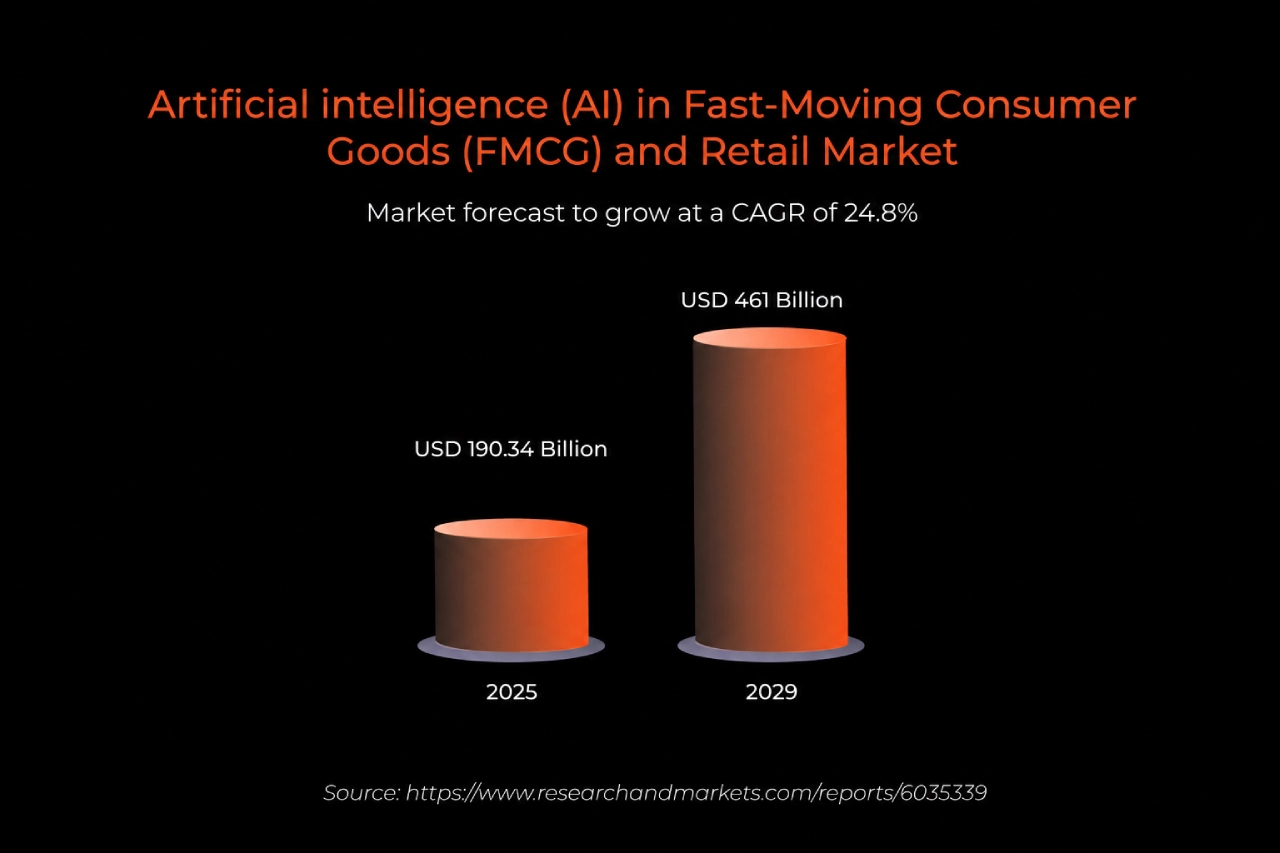
The AI market in FMCG and retail is forecast to grow from $190 billion in 2025 to $461 billion by 2029 at a 24.8% CAGR, and yet somehow BCG's Widening AI Value Gap report (bcg.com, September 2025) found that 60% of companies generate no material value from AI despite investing in it.
The gap between market potential and the value most FMCG companies capture is becoming one of the biggest commercial challenges in consumer goods today. The seven analytics use cases below, already being deployed by leading FMCG players, show where companies are closing that gap.
1. Demand Forecasting & Demand Sensing
Traditional forecasting looks backward; It takes last year's numbers, applies a seasonal index, and hopes the market cooperates. It was never built for a world where a viral trend, a weather event, or a competitor promotion can shift SKU demand 30–40% in a week.
AI-powered demand sensing ingests real-time signals, POS data, social sentiment, weather forecasts, local events, competitor pricing, and produces probabilistic SKU-store forecasts continuously.
The accuracy lift is not marginal: AI achieves 92% forecast accuracy versus 75% for traditional methods, and ML models reduce seasonal forecast error by up to 50%.
The improvement shows up in two ways that matter commercially: Mean Absolute Percentage Error (MAPE) falls by around 22%, and product waste drops by roughly 15% as a direct consequence of not overproducing against inflated forecasts.
PepsiCo's collaboration with major retailers to share data and apply AI-driven analysis has significantly improved forecast accuracy and supply chain efficiency.
Danone improved forecast accuracy by 90% and significantly cut product waste through AI-driven demand and promotional planning.
2. Inventory Optimization
Every FMCG company has the same inventory problem: too many wrong products, not enough of the right ones. Safety stock is the industry's traditional answer: carry excess, absorb the cost, and pray for fill rates. AI replaces prayer with precision.
AI-driven replenishment continuously recalibrates reorder points, safety stock levels, and distribution allocation using the same signals that power demand sensing. Companies that have made the shift are carrying 11% less inventory on average while simultaneously improving fill rates by around 9%, a combination that was structurally impossible under safety-stock logic.
Industry leaders like Unilever reportedly cut food waste by 30% in some regions with AI-driven logistics.
The CFO conversation here is about working capital, and percentage-point reduction in inventory days frees cash for brand investment, innovation, or market expansion.
3. Promotion & Trade Spend Analytics
Trade spend is typically the second-largest P&L line after cost of goods, and most independent estimates suggest that a substantial portion generates no incremental volume or actively cannibalizes other SKUs (i.e., steals sales from sibling products rather than growing total category volume).
Brands often repeat the same promotions year after year because no one has clean data proving they don't work.
AI breaks this cycle. Machine learning models separate true promotional uplift from baseline volume, quantify cannibalization across the portfolio, and simulate scenarios before they are executed.
When FMCG companies apply this rigorously, promotional ROI improves by around 18% and measurable cannibalization across the portfolio falls by roughly 8%, as they only spend on what works.
Inaccurate promotional planning still causes the majority of stockouts, overstock events, and waste in fast-moving categories. This is a solvable problem, and the organizations not solving it are choosing not to. Any team that cannot calculate promotional incrementality within 48 hours of an event's conclusion is leaving margin on the table with full visibility and no plan to recover it.
4. Consumer Segmentation
FMCG brand teams built around demographic archetypes are navigating 2026 markets with 1995 maps. Age and gender bands predict very little about what someone will put in a basket, how often they'll buy, or what it takes to retain them.
AI-powered behavioral segmentation clusters consumers by actual purchase patterns, basket composition, promotion sensitivity, channel preference, and lifetime value. Companies applying this are seeing customer retention improve by around 10% and repeat purchase rates climb roughly 14%, simply from understanding their existing buyers well enough to keep them.
AI-driven segmentation produces 35% more targeted marketing; personalization lifts engagement 50%, and hyper-personalized campaigns have increased customer retention by 28% across the industry.
Danone's use of Google AI for yogurt consumer segmentation drove a 40% CTR increase and 7% incremental sales lift.
5. Retailer & Distributor Intelligence
The manufacturer-retailer information asymmetry is one of FMCG's oldest structural problems. Retailers hold granular POS data. Manufacturers receive aggregated sell-out reports with a lag. Distributors optimize routes for their own cost structures, not for brand availability. The result shows up in the P&L as route inefficiencies and outlet productivity gaps that nobody has a clean line of sight into.
Companies applying distributor and channel intelligence are cutting route costs by around 13% and improving outlet productivity by roughly 16% by doing something deceptively simple: knowing which stores are underperforming their catchment area, which distributors are consistently falling short on service levels, and which routes are consuming cost without proportionate return.
64% of retailers believe they share adequate data with CPG partners, while only 40% of CPG companies agree. Federated learning, where AI learns from distributed retailer data without centralizing it, has delivered 16% forecast accuracy improvements in early FMCG adopters.
Unilever's February 2026 five-year Google Cloud partnership, structured around AI and agentic commerce workflows across its global portfolio, signals where the industry's most sophisticated operators are placing their bets.
6. Assortment & Shelf Optimization
Planogram (a visual blueprint specifying exactly where and how products should be placed on retail shelves) decisions driven by category management intuition and historical volumetrics produce shelf sets optimized for the past. AI produces shelf sets optimized for what the market actually looks like today.
65% of retailers use AI to optimize product placement, and 70% of FMCG companies report higher placement efficiency after AI implementation. The productivity gains show up in two concrete ways: sales per square foot improves by around 7% and shelf out-of-stocks fall by roughly 20% when companies apply AI rigorously to assortment and compliance. Computer vision now monitors shelf inventory with 99% precision, and around 20% of FMCG store audits are already conducted via robots, drones, or AI-equipped cameras. Planogram compliance monitoring alone saves retailers approximately $10,000 per store annually through reduced display errors and missing hero SKUs
7. Pricing & Elasticity Analytics
Annual list price reviews are a legacy of an era when commodity costs, retailer terms, and consumer sentiment moved slowly. None of those things move slowly anymore. Running static pricing against dynamic markets is a structural margin leak.
Companies deploying AI-driven pricing and elasticity modelling are expanding margins by around 6% while retaining over 92% of volume; the kind of outcome that static pricing achieves only by accident. 44% of FMCG firms are already using AI-driven dynamic pricing, and reinforcement learning models have demonstrated 20% uplift in optimizing the pricing-demand relationship. The ability to simulate pack-size changes alongside price moves before executing them commercially is a particular advantage in markets where affordability pressure is pushing consumers to trade down.
P&G's January 2026 earnings commentary explicitly cited AI as the mechanism enabling it to uncover consumer-relevant insights faster than ever in navigating pricing and portfolio strategy across a fragmented media environment.
The Real Barrier Is Not Technology
The BCG AI Radar 2026 found that corporations plan to double AI spend this year, from 0.8% to 1.7% of revenues. Half of CEOs surveyed believe their job stability depends on getting AI right in 2026.
While the intent for the investment is clear, what remains unclear in most FMCG organizations is what to do with it. The companies generating no material AI value are failing because analytics projects are disconnected from commercial decisions; data teams and the people who set prices, plan promotions, and negotiate with retailers are still operating in separate rooms.
FMCG companies pulling away share one trait: they have made analytics inseparable from commercial decision-making. Not adjacent to it. Not informing after the fact. Inseparable from it, in real time. Companies that delay risk ceding 10–15% of market share by 2030 to competitors operating with higher precision and lower cost. Every quarter of the delay is a quarter of data advantage handed to someone else.
Across the seven use cases in this article, from demand sensing to pricing elasticity, Syren's commercial solutions are designed to close precisely the gap between data that exists and decisions that get made. For FMCG teams ready to move from analytics as a reporting function to analytics as a commercial weapon, Syren is at the forefront of leading CPG and Retail companies to change their game.