
Amazon Athena is often one of the first analytics services that teams deploy on AWS. It removes infrastructure management hassles and works directly on data stored in Amazon S3, allowing analysts to query data using SQL without waiting for clusters or pipelines to be provisioned.
While this is great when analytics usage is limited to small teams and irregular query patterns, the problem starts when Athena is used for workloads it was never designed to support. As analytics becomes part of operational workflows, and data outputs influence financial, supply chain, or customer decisions, Athena’s execution model can create friction. Cost, performance consistency, and data reliability shift from secondary considerations to day-to-day operational issues.
This is typically when enterprises decide to move from Amazon Athena to platforms like Databricks for capabilities like real-time integration, governed access, and predictable performance.
What Is Amazon Athena and How It Works
Amazon Athena is a serverless query service that allows users to run SQL queries directly on data stored in Amazon S3. Athena uses a schema-on-read approach, which means data does not need to be transformed or loaded into a warehouse before it can be queried. This makes it suitable for querying raw datasets, logs, and event data in S3 without building ingestion or transformation pipelines upfront.
For teams asking what Amazon Athena is, the practical answer is that it provides fast access to data in S3 without a managed analytics platform.
Amazon Athena for Analytics on Amazon S3
Amazon Athena reduces the upfront effort required to start analyzing data. Teams can run SQL queries directly on S3 data, integrate with AWS-native services, and avoid managing clusters or scheduling ingestion jobs.
It fits naturally into AWS-centric environments, integrates with AWS Glue for metadata, and supports common formats such as Parquet, ORC, JSON, and CSV. This ease of adoption is why Athena is often the first analytics service teams deploy on AWS.
Advantages of Amazon Athena for Ad-Hoc and Exploratory Analytics
Athena performs well when analytics usage is exploratory rather than operational.
It supports ad-hoc analysis, investigative queries, and early dashboards where concurrency is limited and data freshness requirements are modest. With no clusters to provision or tune, engineering effort is limited to query logic rather than platform operations.
Scan-based pricing can also be reasonable when queries are infrequent or unpredictable. For early analytics workloads, this alignment between usage and cost is often acceptable.
Athena was designed for fast access to data in S3, not for long-running, high-concurrency analytics workloads.
Limitations of Amazon Athena for Production Analytics at Scale
Amazon Athena’s limitations become visible as analytics usage grows and becomes business-critical.
- Cost predictability is usually the first issue. Athena charges per terabyte scanned, so costs increase directly with query frequency and data volume. Dashboards that refresh every few minutes, multiple teams querying the same datasets, and inefficient query patterns all contribute to higher and harder-to-forecast spend.
- Performance consistency is another challenge. Athena was not built for high-concurrency BI workloads. Query latency can vary significantly during peak usage, which leads to unpredictable dashboard refresh times during peak business hours.
- Data reliability is a structural limitation. Athena queries immutable files without ACID transaction guarantees. During ingestion or updates, downstream queries may read partial or inconsistent data. Once business users start questioning report accuracy, confidence in analytics erodes.
- Schema evolution is operationally expensive. Changes often require full file rewrites and coordination across producers and consumers, slowing iteration and increasing risk.
- Governance remains fragmented. Metadata, access control, lineage, and auditing rely on a combination of AWS Glue, IAM policies, and custom processes, which becomes harder to manage as compliance requirements increase.
These issues cannot be resolved through tuning alone, as they stem from how Athena executes queries and manages data.
Why Enterprises Migrate from Amazon Athena to Databricks
Enterprises migrate from Amazon Athena when analytics must operate reliably at scale rather than simply answer questions.
Databricks provides a Lakehouse architecture built around managed Delta tables, transactional consistency, optimized query execution, and centralized governance. The migration shifts analytics from file-level querying to managed, transactional data operations.
Databricks Delta Lake provides ACID transactions, controlled schema evolution, and versioning, eliminating dirty reads and stabilizing downstream reporting.
Instead of scan-based pricing, Databricks optimizes data access through indexing, caching, and storage layout optimization, improving cost predictability as workloads scale.
Governance is centralized using Unity Catalog, which enforces consistent access control, lineage, and auditing across analytics and machine learning workloads.
Amazon Athena to Databricks Real-Time Integration Tools Explained
Across these AI in cybersecurity use cases, one requirement shows up repeatedly: decisions only improve when they are grounded in consistent data and governed execution paths.
Databricks supports incremental file ingestion, event-driven pipelines, and low-latency stream processing using Structured Streaming and Delta Live Tables. Data is processed as it arrives and stored in managed tables rather than queried repeatedly in raw form.
This approach reduces repeated scans, improves data freshness, and simplifies pipeline monitoring and recovery.
Challenges in Migrating from Amazon Athena to Databricks
Despite the benefits, migrating from Athena to Databricks is often a challenging task.
Common issues include translating Athena SQL to Spark SQL, preserving complex business logic, validating result parity, and coordinating cutover without breaking downstream reports. Without automation and validation, migrations often stall or produce inconsistent results that delay cutover and erode stakeholder confidence.
SyrenSQLForge2Bricks: A SQL-Dialect-Agnostic Accelerator for Databricks Migrations
In most Athena to Databricks migrations, data movement is not the hardest part. SQL translation is.
Athena queries are written in PrestoSQL semantics, while Databricks SQL is based on Spark SQL. Differences in functions, data types, window behavior, and expression evaluation mean that even syntactically valid queries can produce different results if translated manually. This challenge is not unique to Athena. Similar issues appear when migrating from Trino, MySQL, PostgreSQL, or other SQL engines to Databricks.
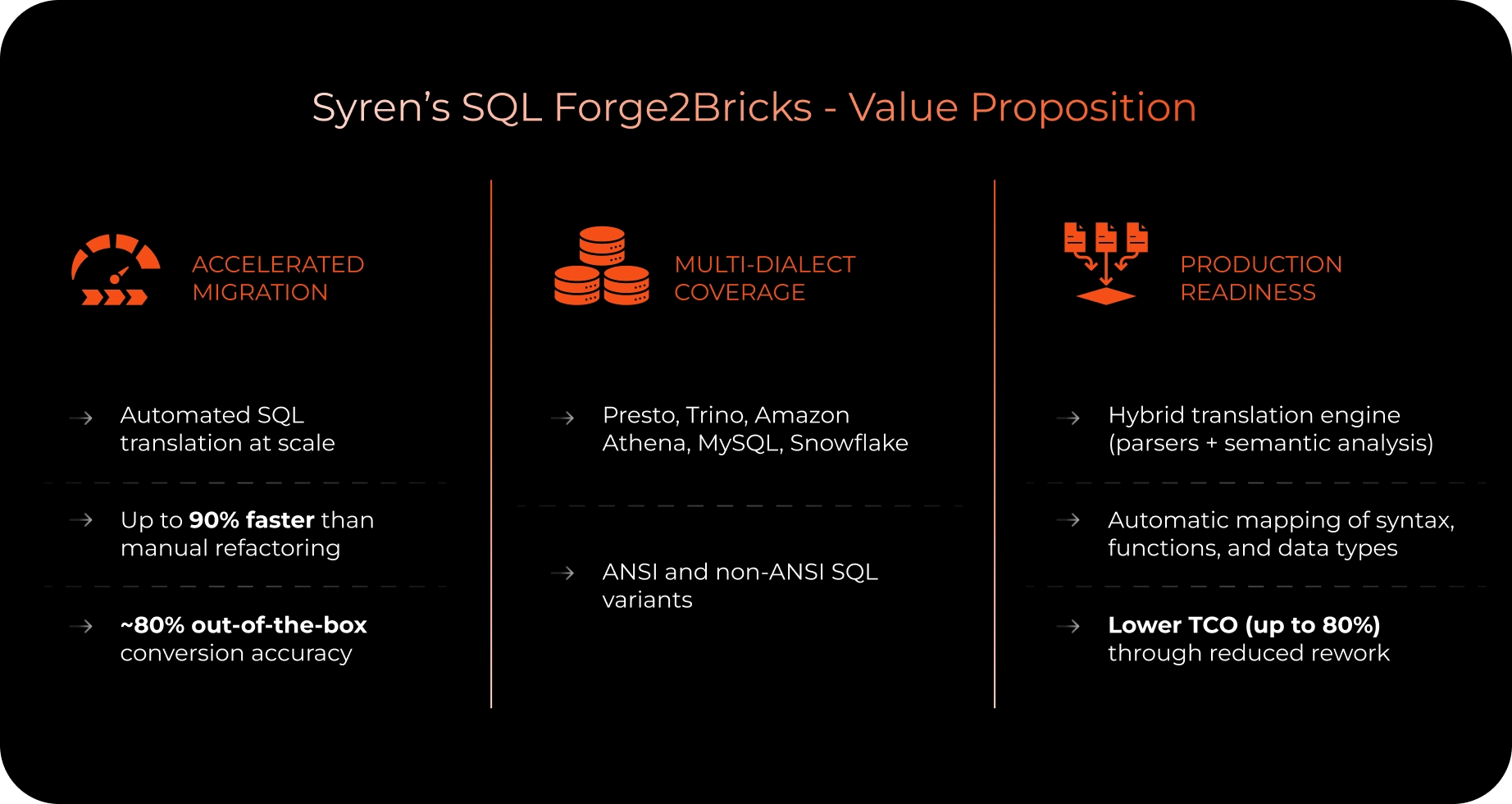
To address this, Syren uses SyrenSQLForge2Bricks, an AI-driven Multi-Dialect SQL to Databricks migration accelerator designed to convert analytics workloads from multiple SQL engines into Databricks SQL.
SyrenSQLForge2Bricks supports SQL migration across Presto, Trino, Amazon Athena, MySQL, and other ANSI and non-ANSI SQL variants. The accelerator combines deterministic SQL parsing, rule-based transformations, and LLM-powered semantic analysis with intelligent AI agents. It automatically translates, validates, corrects, and operationalizes SQL workloads across heterogeneous engines to reduce migration effort, cost, and risk to accelerate Databricks adoption.
Delivering Proven Results with Syren’s Athena to Databricks Migration Accelerator: SQLForge2Bricks
Syren has applied its Athena to Databricks Migration Accelerator, SQLForge2Bricks, in production environments where Amazon Athena created cost, performance, and data reliability constraints.
In one engagement, a fast-growing, data-driven enterprise running analytics on Amazon Athena faced rising query spend, inconsistent performance during peak usage, and unreliable downstream reads due to the absence of transactional guarantees. Using Syren’s migration accelerator, the organization migrated its analytics workloads to Databricks in just 25 days.
Average query latency dropped by 60%, reducing execution time from roughly 45 seconds to 20 seconds. Storage and processing overhead decreased by 15% through Delta table optimization and improved statistics. Query parity across critical workloads reached 95%, enabling cutover without disrupting reporting users.
The migration enforced ACID consistency through Delta Lake, centralized governance with Unity Catalog, and stabilized performance under concurrency.
Databricks-Aligned Migration Approach Used by Syren
As a Databricks partner, Syren aligns migration architecture with Databricks-recommended patterns, including Delta Lake for transactional storage and Unity Catalog for governance.
This ensures migrated workloads are optimized for long-term performance, cost control, and maintainability rather than simply re-hosting Athena queries on a different engine.