Syren TrueTrack is a real-time order visibility portal built on a single Databricks Lakebase instance; no separate analytics warehouse, no standalone transactional database, and no sync pipeline between them. We built it for a leading Indian power and distribution transformer manufacturer that needed real-time order visibility for its customers and its internal teams, and it skips the three-system architecture this kind of portal normally takes.
Most order-tracking portals run on three moving parts: an analytics warehouse holding the ERP data, a separate transactional database for what users do in the app, and a pipeline shuttling data between them. Each part is one more thing to run, secure, and keep in sync.
TrueTrack runs without the warehouse-to-app pipeline and without the standalone OLTP database. Lakebase did both jobs. Here is the situation, what we shipped, and the three patterns that made a single-database design hold up in production.
The problem: a lifecycle no one could see end-to-end
The manufacturer builds power and distribution transformers for large industrial and infrastructure projects. An order moves through presales, design engineering, manufacturing, customer inspection, and dispatch. That journey lived across enterprise systems and offline spreadsheets, with manual handoffs at every stage.
Two things followed. Customers had no reliable way to check where an order actually stood. And internally, engineering, planning, procurement, quality, and logistics each held one piece of the picture, with no shared view of the whole.
What they wanted was not another reporting dashboard. It was a live operational system: one that external customers could log into, that supported the internal roles working an order day to day, and that stayed current with the ERP, all inside Databricks.
What we built: one portal, two audiences
The TrueTrack portal has two faces backed by the same data.
Customers get a B2B order tracking portal secured with OTP login. They follow an order across six lifecycle stages, from opportunity through dispatch, open documents, and handle drawing approvals.
Internal teams get an operations tracker secured with single sign-on through Microsoft Entra ID. Eleven roles across central planning, design, procurement, production, quality, finance, and logistics record milestones that used to sit in offline files: uploading drawings, approving work-order stages, logging inspection results, clearing dispatch.
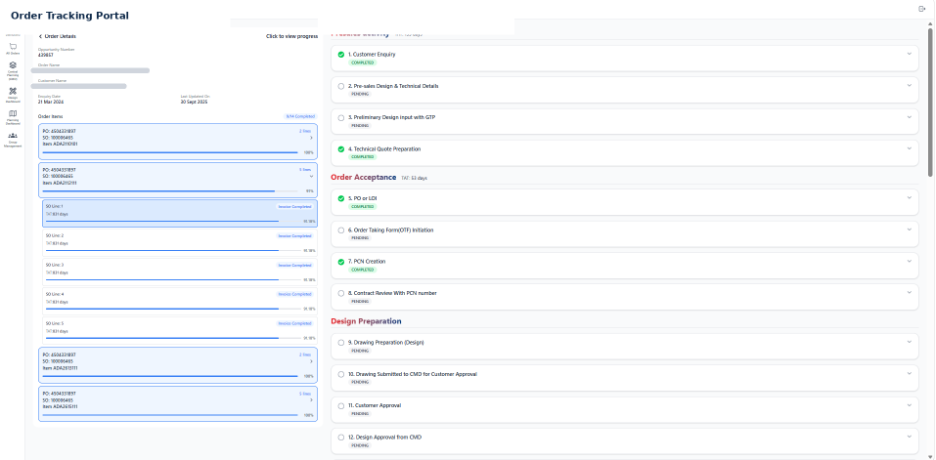
An internal order view: ERP-sourced order lines on the left, live milestone tracking per lifecycle stage on the right. Customer and order identifiers are masked.
The part worth dwelling on sits underneath the screen. Databricks Lakebase is the only operational database in the system. It takes the live writes from internal users, and it serves the ERP-sourced data the portal reads, over one connection.
Three patterns in production
1. Transactional UX on Lakebase Postgres
The TrueTrack portal is a real web application: a React front end talking to a FastAPI backend, and that backend reads and writes only to Lakebase PostgreSQL. Every action an internal user takes, an approval, an upload, an inspection record, a dispatch confirmation, is a write straight to Lakebase. It carries the latency an interactive app needs, with no separate OLTP database anywhere in the picture.
Because Lakebase is serverless, fully managed Postgres, there was nothing to provision, no connection pooling to babysit, and no database administration to staff. The team spent its time on application logic instead.
2. Reverse ETL without a CDC pipeline
The manufacturer's Oracle ERP, CRM, and CPQ data lands in the Databricks Lakehouse every day and runs through a Medallion pipeline into business-ready Gold tables.
Normally you would now build a reverse ETL job to push that Gold data into whatever database the app reads from. We didn't. Databricks Scheduled Sync replicates the Gold Delta tables directly into Lakebase as read-only Postgres replicas. The portal reads customers, opportunities, sales orders, work orders, and invoices from the same Lakebase instance it writes application data to.
One database. One connection. No custom change-data-capture. After each daily build, the fresh ERP data is simply there.
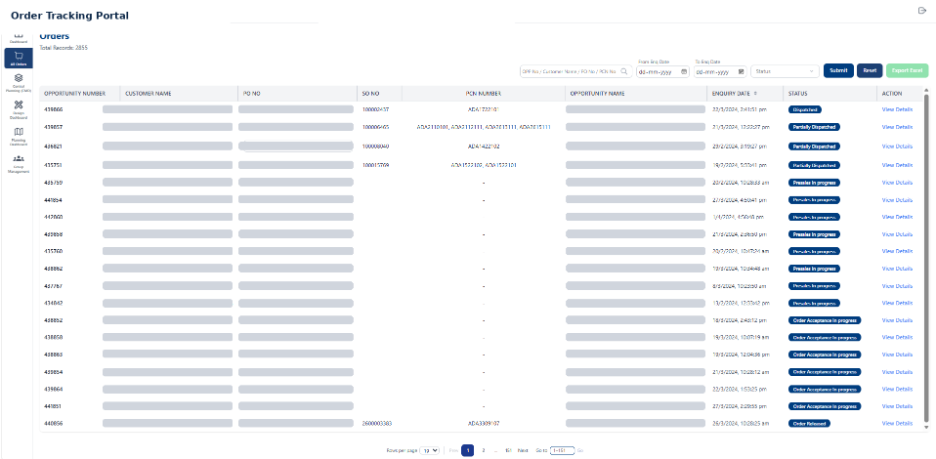
The internal orders list across the full book of work (2,855 records). Customer names, PO numbers, and opportunity names are masked; lifecycle status is not.
3. A unified view across two data worlds
TrueTrack’s main job is to present one coherent order lifecycle that stitches together two very different kinds of data:
- ERP-sourced records: customers, purchase orders, sales orders, work orders, and invoices, all from Oracle by way of the Medallion pipeline.
- Live tracker records: engineering milestones, design approvals, planning updates, and inspection results, entered by internal teams as they happen.
Both categories live in Lakebase, so the backend assembles a unified order view with no cross-database joins, and no API aggregation layer sitting in front. A customer sees the whole order journey on one screen. An internal user sees ERP history next to live updates, at the response times a web app has to hit.
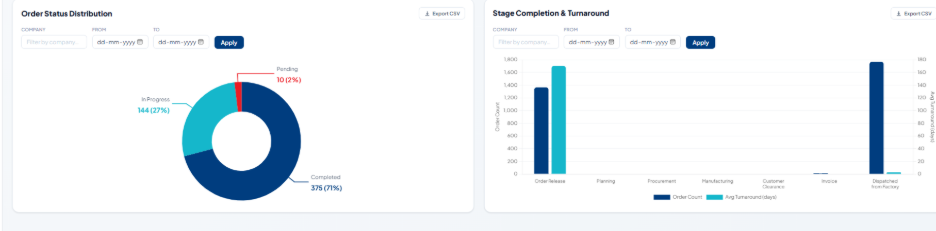
Internal analytics on order status and stage turnaround, read from the same Lakebase instance that serves the app.
What the architecture eliminated
Built the usual way, this portal needs three systems: an analytics warehouse for the ERP data, a transactional database for the app, and a sync layer between them. Each one adds infrastructure, latency, a place for things to break, and steady work to keep everything consistent.
Lakebase folded all three into one. The Lakehouse became the application database. Gold tables became something the portal could read directly. Synchronization stopped being an engineering project and turned into a Databricks configuration.
Live in production
Syren’s TrueTrack is in production today, tracking the full order lifecycle from presales to dispatch in one place that both customers and internal teams use.
If you run a discrete manufacturing or industrial business on top of an ERP, and you want real-time operational visibility in front of customers and staff without leaving Databricks, this pattern transfers directly.